Before you buy, we already checked whether your gear will pass tech at the event you care about. Every product on Gara is cross referenced against the current rulebook of every org that host track days and races. Hover a badge below to see the exact requirement text, pulled from that org's rulebook on the date we last verified it.
Pick your helmet. We'll show you its Snell certifications and which racing organizations accept it, pulled live from each org's current rulebook.
DOT certification is assumed for any helmet sold for US street use. Rules update, always check the org's current tech inspection page on race day. Source rulebooks scraped from each organization's published rules.
Pick a brand and model above to see where your helmet's accepted.

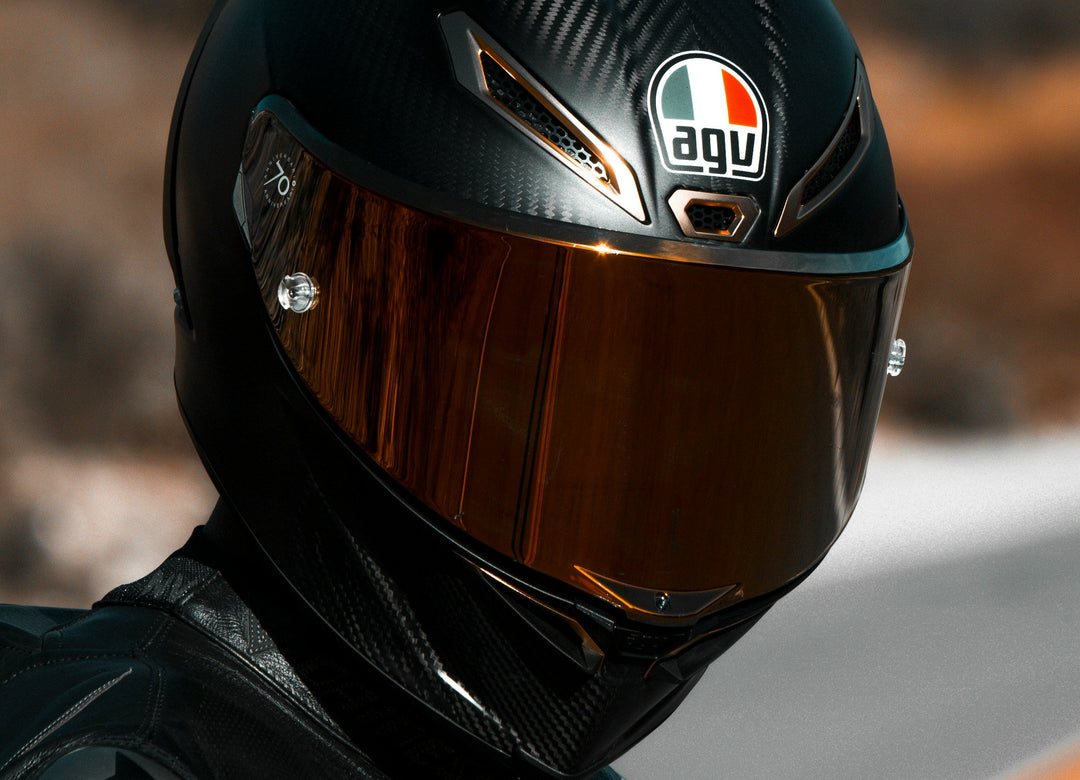
Real product, real certs, live rulebook data. The Pista GP R is AGV's top tier road racing helmet, carbon fibre shell, FIM homologated for MotoGP and WSBK, and the reference helmet most US club orgs accept by default. Its supplier claimed certs below have been cross checked against each cert body's public records.
Hover any org badge to see what that org's current rulebook actually says about helmets, including which certs count, the date we last verified, and a link straight to the source PDF. On a live product page this same badge row renders from the product's tags; the certs + org approvals update the moment a rulebook changes.
Requirements verified monthly against each org's current rulebook. Always confirm with your event organizer.
DOT, ECE 22.06, Snell M2025 and FIM FRHPhe-01 sound interchangeable on a product page, but the test protocols behind them are radically different. Understanding which one your event org accepts, and why, is the difference between passing tech inspection and packing the truck back up.
The US legal floor for street use. Manufacturer self certifies that the helmet meets impact attenuation, penetration, retention, and peripheral vision tests; NHTSA pulls random samples for verification. Passing DOT is mandatory to sell a helmet for road use in the US, but it's the lowest bar of the four standards.
The 2020 successor to ECE 22.05. Adds rotational acceleration limits, doubles the number of impact zones tested, and introduces oblique impact protocols modeling real crash angles. Every batch is independently lab tested, not self certified. Mandatory across the EU and accepted by most US motorcycle racing orgs in place of (or alongside) Snell.
A voluntary US standard that's stricter than DOT and ECE on energy thresholds and uniquely demands multi impact testing on the same shell. Each helmet model is individually submitted; only models on Snell's Certified Product List can wear the decal. Common requirement at US club road racing (WERA, ASRA, CMRA), and the only standard accepted in some kart and amateur auto orgs.
The FIM's racing specific helmet standard, required for all FIM sanctioned road racing including MotoGP, World Superbike and MotoAmerica pro classes. Built on top of ECE 22.06 with additional rotational acceleration limits and oblique impact protocols at racing speeds. Each homologated helmet carries a unique FIM number you can verify on the public FIM Helmets list.
Hierarchy in plain English: if your helmet carries Snell M2015 or newer, ECE 22.05 or newer, or any FIM FRHPhe number, you're cleared for nearly every US motorcycle club track day and race. DOT only helmets are legal on the street and accepted at many track days, though some club racing organizations require Snell, ECE, or FIM.
Each sanctioning org publishes a rulebook, MotoAmerica, WERA, ASRA, N2, STT, CMRA, OMRRA, WMRRA, Penguin and 50+ others. Our system indexes the current version of every rulebook, reads the gear requirement sections, and stores the exact text alongside the date we verified it.
When a helmet, suit, glove, or boot gets listed, we record the certifications it actually carries, Snell M2020, ECE 22.06, FIM FRHPhe-01, DOT, CE Level 2, and the discipline it's built for.
For each product, its certs are compared against each org's current rule set and marked Approved where the certs satisfy the rule. That's what drives the badges on the product page. When a rulebook changes, the badges follow within the same week.
Pulled from the live rulebook of every US motorcycle road racing and track day org we've indexed. The cert column shows the minimum standards that org currently accepts. Newer versions in the same family always satisfy older ones, an ECE 22.06 helmet meets a "ECE 22.05+" requirement, a Snell M2025 helmet meets "Snell M2020+", etc.
| Org | Type | Helmet Certs Accepted | Last Verified |
|---|---|---|---|
| Loading rulebook data… | |||
Re indexed monthly. Orgs whose rulebook doesn't list explicit cert standards (e.g., simply requires "full face") are shown but flagged for manual confirmation with your event organizer.
Pulled from … indexed rulebooks. Orgs without a public rulebook or whose rulebook hasn't been re indexed yet are not shown here. The monthly pipeline expands this list.
Buying a track helmet online without checking your event org's rulebook is the most common reason riders get turned away at tech inspection. Use this four step workflow before you click buy.
The track itself almost never sets the gear rules, the sanctioning organization running the event does. Open the Gara Track Finder, search your track, and look at which orgs host days there. A track day at Barber under STT has different rules than a club race at the same track under WERA.
Hover any org badge on this page (or scroll up to the orgs reference table) to see the exact rulebook text and the date it was last verified. Most US club road racing orgs accept Snell M2015 or newer, ECE 22.05 or newer, or any FIM FRHPhe homologation. School programs and entry level track days are usually less strict.
Find your helmet's cert markings (see the verification guide below). If your helmet carries a current Snell, ECE 22.06, or FIM sticker, you'll satisfy nearly every US club moto org. If you only see DOT, you'll need to upgrade for most track use. Newer versions satisfy older requirements automatically, that's how cert family hierarchies work.
Rulebooks update mid season, and tech inspectors occasionally interpret the same rule differently. Always email the organizer your helmet's exact cert markings before the event. One $0 email saves you a $400 weekend if the answer is no.
Every helmet sold legally for road or track use carries permanent cert markings, not stickers that fall off, but heat stamped or molded labels in specific locations. Here's where to look on each one, and how to independently verify.
Look for a sticker on the lower back of the helmet shell with "DOT" in clear capitals plus the manufacturer's name and model. The decal should be color fast and precisely placed, counterfeit "DOT approved" helmets at swap meets often have crooked or peeling labels. DOT is self certified, so verification beyond the sticker means buying from a reputable dealer.
Pull back the chinstrap and look for a white tag with text like "E1 22-06 / ABCD-1234". The "E#" is the country code that issued the cert (E1 = Germany, E3 = Italy, etc.), "22-06" is the standard version, and the trailing chars are the batch ID. Any number 22-05 or higher is current enough for most US club orgs.
Lift out the comfort liner if needed. Look for a foil decal on top of the EPS foam reading "Snell M2020" or "Snell M2025" (older M2015/M2010 still acceptable at most orgs). Verify the model on Snell's public Certified Product List at smf.org/cert , if the exact make and model isn't listed, the decal is suspect.
Look for a sewn in label with "FRHPhe-01" plus a unique FIM number (e.g., FRHPhe-01-XXXX). Each FIM homologated helmet has its own serial, not a per model batch, so verification is one to one. The public FIM Helmets list is searchable by helmet name and FIM number; if your serial isn't on it, the homologation isn't real.
DOT FMVSS 218 is the US federal minimum, manufacturer self certification with random spot testing. ECE 22.06 is the current European standard, mandatory in 50+ countries, with batch testing across more impact points and rotational acceleration limits. Snell M2025 is a voluntary, stricter standard with multi impact testing on the same shell, common in US club racing. FIM FRHPhe-01 is the racing specific top tier required for MotoGP, World Superbike and MotoAmerica, adds rotational and oblique impact protocols beyond ECE 22.06.
MotoAmerica requires FIM FRHPhe-01 for pro classes; WERA, ASRA, CMRA, OMRRA, WMRRA and most club road racing orgs accept Snell M2015 or newer, ECE 22.05 or newer, or FIM FRHPhe-01. Track day schools like N2, STT, 2Fast, Penguin, MotoVid and Apex Assassins accept the same cert family. Gara indexes the live rulebook of every org monthly so the badges on each helmet update when the rules change.
If your road helmet carries a current Snell M series, ECE 22.06, or FIM FRHPhe-01 sticker, most US track day orgs will accept it. DOT only is generally not enough for moto track days, N2, STT, 2Fast and most club orgs require Snell or ECE 22.06 minimum. Check the helmet's label inside the chin bar against your event org's current rulebook before you load the truck.
Every org's rulebook is re indexed monthly. When a rulebook changes, the affected helmets, suits, gloves and boots get re evaluated within the same week and the badges on the product pages update automatically. Each badge tooltip shows the exact date that org's data was last verified.
Most US club road racing orgs (WERA, ASRA, CMRA, OMRRA, WMRRA, Penguin) accept Snell M2015 or newer, but they also accept ECE 22.05+ and FIM FRHPhe-01 in place of Snell. AGV, Arai and Shoei top tier helmets often homologate to FIM and ECE rather than Snell, and they're still legal at every major US club. The exception is some kart and amateur auto orgs that require Snell SA series specifically.
FRHPhe-01 stands for FIM Racing Homologation Program for Helmets, version 01. It's the FIM's racing specific helmet standard, introduced in 2019 and required for all FIM sanctioned road racing including MotoGP, WSBK, and MotoAmerica pro classes. Adds rotational acceleration limits and oblique impact testing on top of ECE 22.06. Each homologated helmet carries a unique FIM number you can verify on the FIM Helmets list.