






Save Money on Motorcycle Tires
The honesty-about-skill rule that keeps your wallet and your collarbones intact.
Somewhere in the paddock this weekend, a rider is bolting $450 of race rubber onto a bike they bought six months ago. First out-lap of the first session, they'll tip into Turn 1, the cold tire will do exactly what cold DOT race rubber does (nothing), and the front will wash before the apex. The ambulance ride, the new fairing set, the bruised ego — that's where the hard lesson lives.
The tires were fine. They were just wrong for that rider on that day.
This guide is the honest conversation you don't get from a glossy product page. We're going to walk through the tire spectrum, explain why the stickiest rubber on the market will crash you if you can't feed it heat, and show you how to save real money by buying for the rider you actually are instead of the rider you hope to be three seasons from now.
The Tire Spectrum, Without the Marketing
Motorcycle track and sport tires sit on a spectrum. On one end are tires built to work from cold, last 10,000-plus miles, and forgive riders who are still learning what grip feels like. On the other end are race slicks with no tread, no operating window under 75°C, and a habit of turning cold corners into lowsides. There are four real categories you should understand.
1. Sport-Touring
Price per set (front + rear): $280 to $360. Lifespan: 8,000 to 15,000 miles. Works cold? Yes, within a single corner.
Examples: Michelin Road 6, Pirelli Angel GT II, Dunlop RoadSmart IV, Bridgestone T32, Metzeler Roadtec 01. These are built for commuting, touring, and spirited road riding. The compound is hard enough to roll cold at 40°F without drama, and the carcass is designed for mileage. Grip is more than adequate for a novice-group track day. At that pace, the tire isn't the limiter.
2. Hypersport Street
Price per set: $360 to $440. Lifespan: 4,000 to 6,000 street miles, or 2 to 4 track days before meaningful wear. Works cold? Yes, after one warm-up lap.
Examples: Michelin Power 6, Pirelli Diablo Rosso IV, Dunlop Sportmax Q5S, Bridgestone Battlax S23. These are the grown-up version of a street tire. Dual-compound carcass, soft shoulders for lean, harder center strip for wear. Most intermediate track-day riders should live here. The tire grips more than most riders can use, and it still rolls out of the garage without warmers.
3. Hypersport Dual-Purpose (DOT-approved Trackday)
Price per set: $420 to $520. Lifespan: 1,500 to 2,500 street miles, or 3 to 5 track days. Works cold? Marginally. These perform best with a committed warm-up or tire warmers.
Examples: Pirelli Diablo Rosso IV Corsa, Pirelli Diablo Supercorsa SP V4, Michelin Power Cup 2, Dunlop Sportmax Q5, Bridgestone RS11. These are crossover tires. DOT-legal so you can ride home from the track, but engineered for the 20-minute sprint of a track-day session. The compound is soft enough that sustained highway use cooks the center strip in a weekend. This is the right tier for advanced track-day riders who already feel grip variation at the edge of the tire.
4. DOT Race and Slicks
Price per set: $460 to $620 (DOT race), $420 to $560 (slicks). Lifespan: 1 to 3 track days at race pace, or 1 to 2 race weekends. Works cold? No. Tire warmers are not optional.
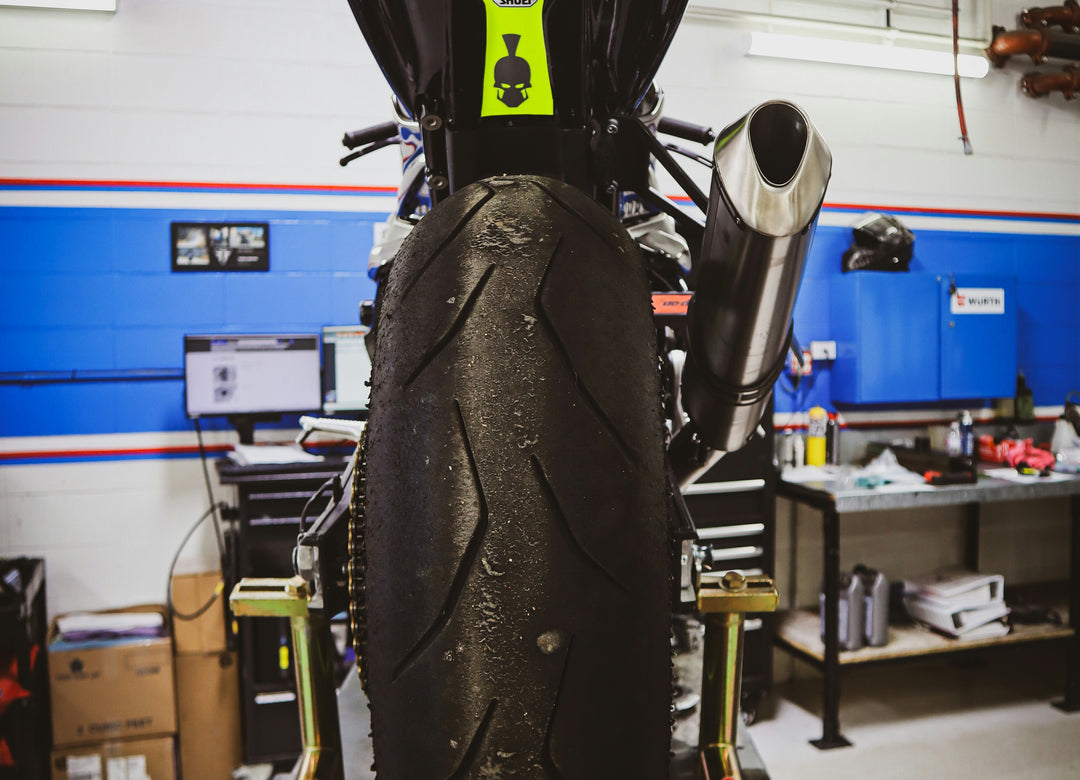
Examples: Pirelli Diablo Superbike slick, Michelin Power Cup (race compound), Dunlop KR TD, Bridgestone V02 slick. These tires are engineered to live between 75°C and 90°C and deliver grip that would terrify a street rider. Below 60°C, they offer less usable grip than a stone. A racing tire is a precision tool, and precision tools perform only in the narrow band they were built for.
Tire Warmers: The Line Item Nobody Mentions
When a buddy tells you "just throw race slicks on it, they're the best tire in the paddock," he's technically correct. He's also technically telling you to light $900 on fire, because here's the actual gear list a race-compound tire demands:
- Tire warmers: $300 to $900 per set (front + rear). The Chicken Hawk Standard set is the low end. Top-tier Thermal Tech or Woodcraft dual-temp sets run close to $900.
- Generator: $180 to $600 if you don't already own one. A 2000W inverter like the Honda EU2200i is the paddock standard.
- Extension cords, power strips, stands: another $80 to $150 in miscellaneous paddock infrastructure.
- Time: 30 to 45 minutes of pre-warm before every session. At a typical 4-session track day, that's 2 to 3 hours of your day spent babysitting heaters.
You're now looking at roughly $1,200 of overhead wrapped around a $500 set of tires, and that's before you talk about the tire pressure gauge calibrated for hot psi or the pyrometer you'll want for reading temperature across the carcass.
Tire warmers don't make race tires faster. They make race tires functional. Without them, a race tire at 20°C ambient has measurably less grip than a sport-touring tire at the same temperature.
Second thing nobody mentions: even with warmers, a race tire cools down between sessions. Pull it off the warmer, let it sit for 15 minutes through tech inspection, and you've lost the heat. Pro racers ride straight from warmer to grid. Novice track-day riders wander the paddock, chat with friends, use the restroom, then show up to Turn 1 on a $500 tire that's now a $500 liability.
Where You Actually Sit in the Rider Group
Every track-day organization on earth runs the same three or four skill groups. The names change. Green / Yellow / Red / Black at one org, Novice / Intermediate / Advanced / Expert at another. The definitions are remarkably consistent. Be honest about which one describes you today. Not yesterday, and not next season.
Novice / Green / "Passing only in designated zones"
You're still learning lines. Your body position is inconsistent between corners. You can't yet tell the difference between running out of grip and panicking and rolling off mid-apex. Most track-day riders spend their first 5 to 10 full days here, and that isn't failure. It's where the sport is actually taught.
Intermediate / Yellow / "Passing anywhere with a bike-length"
You've got consistent lines. Body position is instinctive. You read grip in real time and adjust on the fly. Advanced riders are passing you in the fast sections but you're holding your own through the technical bits.
Advanced / Red / "Race-style passing"
You're at the edge of available grip on a hypersport street tire. You read weather, track temperature, and tire wear in real time. You've got your own pressure preferences per brand. Instructors have flagged you for consideration in the top group.
Expert / Black / Racer
You race, or you ride at near-race pace in an unrestricted group. You can distinguish front-end grip from rear-end grip in the same corner. You know what chatter feels like at 60° of lean, and you know what's wrong with the bike when it starts.
Matching Tires to Where You Actually Are
Here's the short version, with specific models and what to buy today.
| Skill Level | Tire Category | Specific Models | Warmers? |
|---|---|---|---|
| Novice | Sport-Touring or Hypersport Street | Michelin Road 6, Pirelli Rosso IV, Dunlop Q5S | No |
| Intermediate | Hypersport Street | Michelin Power 6, Pirelli Rosso IV, Bridgestone S23, Dunlop Q5S | No |
| Advanced | Hypersport Dual-Purpose | Pirelli Rosso IV Corsa, Pirelli Supercorsa SP V4, Michelin Power Cup 2, Dunlop Q5 | Optional |
| Expert / Racer | DOT Race or Slick | Pirelli Diablo Superbike, Dunlop KR TD, Bridgestone V02, Michelin Power Slick | Required |
Notice what's missing from the Novice and Intermediate rows: the race-compound track tires. A novice on a race slick isn't a faster novice. They're a novice on a tire they can't heat up, can't keep heat in, and will lose grip the second they back off their pace because the carcass cools faster than they can reload it. A novice doesn't "run out" of grip the way an advanced rider does at the limit of adhesion. A novice loses grip because they can't push the tire hard enough to generate the heat it was designed around. The tire is smarter than the rider, and that's the wrong hierarchy.
The Real Math: What Tires Actually Cost Over a Season
Let's isolate the tire-related spend for a novice rider doing five track days a year. We are not pricing out a full season budget here. Track-day fees, fuel, hotels, food, and gear are excluded. This is just what the tires themselves drag onto your credit card, plus the downstream costs that come with the wrong tire choice.
Scenario A: The Honest Choice (tire-related costs only)
- One set of Pirelli Diablo Rosso IV (hypersport street): $400
- Five track days on those tires, zero replacement mid-season. Still serviceable for commuting afterward.
- Tire warmers needed: $0
- Generator and paddock gear for tire heat: $0
- Tire-related total for the season: $400. Tire cost per track day: $80.
Scenario B: The Ego Choice (tire-related costs only)
- One set of race-compound DOT race tires: $540
- Second set mid-season because the first set corded after three days: $540
- Tire warmers, bought in a panic after a cold-tire slide: $450
- Portable generator to run the warmers: $250
- First-year crash repair after a cold-tire lowside on the out-lap. A direct consequence of the tire choice, not a separate accident. Conservatively $1,800 in bodywork, levers, bar ends, and a clutch perch. Plus a mental setback that costs two of the five days on the schedule.
- Tire-related total for the season: roughly $3,580. Tire cost per track day: $716.
The difference isn't subtle. The tire side of Scenario B is nine times more expensive than Scenario A, produces fewer days on track, and actively slowed the rider's development because the tire wasn't teaching them what grip felt like. It was masking everything.
The Safety Argument Nobody Wants to Make
Both street tires and race tires give you plenty of feedback. That isn't the issue. The issue is that they're built to work in completely different operating windows. A Michelin Road 6 is designed to make grip at street temperatures on a cool morning. A race-compound slick is designed to make grip at 80°C after 15 minutes of aggressive pace. Both work beautifully inside the window they were built for. Outside of that window, you aren't on a tire with "bad feedback." You're on a tire that's out of spec for what you're asking it to do.
Here is why that matters for a newer rider. Race tires only stay in their window when you keep feeding heat into the carcass corner after corner. That takes pace a novice doesn't have yet, and shouldn't. Put a novice on a race slick and they spend the session on rubber that's cooling off faster than they can reload it. Physically, that tire starts behaving like a much harder, much lower-grip compound than the hypersport street tire they would have been on instead. The feedback is still there. It's just feedback from a cold, underworked tire the rider assumes is a hot, sticky one.
That assumption is where the incident starts. The rider leans the bike based on what race rubber is supposed to do, not what cold race rubber actually does. The lean angle their friends get away with, the throttle input they saw on YouTube, the line their advanced buddy rides. All of that was built on a tire in its window. Cold race rubber won't hold any of it.
The right tire for a novice isn't a tire with more warning. It's a tire whose operating window lines up with the pace the novice can actually generate. A hypersport street tire is designed to give you real grip at novice-group pace, on a cool morning, from the first corner of the first session. That match between tire and rider is what margin looks like, and in a sport where a small mistake costs four figures of repair, it's the cheapest thing you can buy.
How to Graduate to the Next Tire
You don't buy the upgrade first. You earn it, then you buy it. Graduate to a more aggressive tire only when you can check all three of these boxes.
- Your instructors bumped you to the next skill group. Not your friends. Not your ego. The track-day org's coaches.
- You're running out of grip in the literal sense of sliding at corner exit under throttle, consistently, over multiple sessions. "I feel nervous leaning it over" is a rider issue, not a tire issue.
- You own the support gear. If the next tier up needs warmers, you have warmers and a generator today, not "soon."
Most riders should spend two full seasons on hypersport street tires before they consider a DOT race tire. That isn't hedging. That's how the sport is supposed to be learned.
Beyond Tires: The Same Honesty Rule
This framework generalizes. You don't need the $2,400 Tech-Air airbag system on day one, but you do need a CE Level 2 back protector. You don't need the full kangaroo-hide race suit, but you need a real one-piece or zip-together leather suit with CE armor, not a textile commuter jacket. For a helmet, you need a full-face with real certification behind it. See the live rulebook data for what your specific sanctioning org accepts.
The pattern stays the same at every gear category. Match the equipment to the skill. Layer in premium gear when you're actually operating in its window. Skip the fantasy purchases that cost money without making you safer.
Frequently Asked Questions
Do I need tire warmers for track days?
Only if you're running DOT race tires or slicks. Sport-touring and hypersport street tires are designed to work from cold within a single out-lap. Warmers are mandatory infrastructure for race-compound rubber, not a performance upgrade for the tires most riders should be on.
What tires should I buy for my first track day?
Whatever hypersport street tire fits your bike in a middle-of-the-road compound. Michelin Power 6, Pirelli Rosso IV, Bridgestone S23, and Dunlop Q5S all work excellently for novice and intermediate track-day riders. Any of these will outgrip your skill level for at least two full seasons.
How long do hypersport tires last at the track?
Budget three to five track days per set for a hypersport street tire used hard at the track, or four to six thousand street miles if you mix commuting with occasional track use. DOT race tires drop to one to three track days depending on pace and how well you manage temperature.
What's the difference between DOT race tires and slicks?
A DOT race tire has legal tread depth to pass U.S. Department of Transportation requirements and can technically ride home from the track. A slick has no tread grooves and isn't legal on public roads. Both need warmers. Both offer similar grip at operating temperature. Choose DOT race if you ride to and from track days. Choose slicks only if you trailer the bike.
Can I do a track day on sport-touring tires?
Yes, and if you're a novice you probably should. Sport-touring tires carry more than enough grip for novice-group pace, they work cold, they tolerate multiple heat cycles, and they cost less. At that stage of your riding, the tire isn't what's holding you back.
Which is better: Pirelli Supercorsa SP V4 or Michelin Power Cup 2?
They're peers in the hypersport dual-purpose tier. Both are DOT-legal, both scrub in on an out-lap without warmers, and both are designed for the sprint of a track-day session rather than a highway commute. Pirelli tends to feel more progressive at the limit. Michelin tends to hold more consistent grip across a full session. If you're not already at the edge of grip on a hypersport street tire, the honest answer is "neither," because you should be one tier lower.
If I'm not going to do track days, can I still buy sport-touring tires?
Absolutely. Sport-touring tires are an excellent choice for street riders who want sharp handling and long tire life without the short-lifespan penalty of hypersport rubber. Most experienced street riders never need anything more aggressive than a tire in this category.
The Short Version
Be honest about the rider you are today. Buy the tire that matches that rider, not the tire that matches the rider you want to be. Learn the craft on forgiving equipment. Graduate when your instructors tell you you've earned it, not when your wallet tells you you can afford it. The fastest-looking tire in the paddock is almost never the right tire for the rider buying it.
You'll save money. You'll learn faster. You'll crash less. And the day you finally pull on a set of warmers and a pair of Supercorsas, you'll be ready for what they actually do.